
Criminal Court Cases in Perry County
Perry County sits in Alabama's Fourth Judicial Circuit. The Circuit Court's criminal jurisdiction includes felony prosecutions. District Court handles misdemeanors, felony preliminary proceedings, and state or county traffic matters under its own statutory jurisdiction. A felony arrest can therefore produce an early District Court entry before the main prosecution reaches Circuit Court. The court name and case number matter as much as the defendant's name when matching a result.
The Perry County Circuit Clerk is the official record keeper for Circuit and District proceedings. The clerk records pleadings, notices, court-ordered money, warrants, case-action summaries, orders, and dispositions. Marion and Uniontown municipal courts keep their own city matters. A municipal ticket or ordinance case is not promised by a Perry County-only paper search, so the court listed on the citation or docket should control the next request.
Perry County Court Filings in Context
The Alabama Administrative Office of Courts reported 171 Perry Circuit filings in fiscal year 2022, with 41 percent classified as criminal. It reported 1,499 District filings, with 6 percent criminal and 76 percent traffic. Those figures describe an older filing year, not present crime levels. They do show why a broad Perry County court search can return several kinds of entries and why the court division must be checked before drawing a conclusion.
Marion remains the hub. The courthouse dates to 1855, yet its clerk now works beside statewide electronic access. A paid case detail may answer a fast docket question, while a clerk request supplies the precise paper or certified item. Neither route is a statewide fingerprint history or a city court archive.
Note: Historic filing totals describe court workload and must not be read as current Perry County crime counts.
Perry County Case Record Searches
Just One Look is the on-demand Alabama trial-court route. Alacourt.com is the subscription, read-only alternative with case detail and document images. When neither route supplies the needed Perry County record, use the clerk's request form by mail or delivery, call the clerk at (334) 683-6106, or ask at the clerk counter in Suite 110 of the Perry County Courthouse, 300 Washington Street, Marion. City cases require the municipal clerk, and federal criminal cases require PACER rather than a county search.
- Choose a Just One Look name search or case-number search. A case number is the stronger key when it is known.
- Confirm Perry County, the court division, filing date, and party details before buying or relying on case detail.
- Read the case status, court action, setting dates, and case-action summary. Keep a pending charge separate from a final result.
- Use the Perry clerk form when an older file, warrant copy, indictment, signed order, judgment, or certification is needed.
- Mail or deliver the request, allow seven working days, and pay the stated amount when the copies are delivered.
The two channels collect different inputs. The portal's public interface exposes name and case-number search modes, while paid fields beyond that point were not publicly visible. The county PDF gives a fuller request inventory.
| Channel or Field | Type | Required | Format or Use |
|---|---|---|---|
| Just One Look name | Name search | Mode choice | Confirm identity with court and case details |
| Just One Look case number | Case search | Mode choice | Use the Alabama case identifier when known |
| Defendant's name | Text | Expected | Criminal record request identifier |
| Charge | Text | Not specified | Add the known filed charge |
| Case number | Segmented text | Not specified | Use the pattern printed on the form |
| Date of birth | Date | Not specified | MM/DD/YYYY |
| Record or copy | Checkboxes | Select applicable | Choose the exact document or complete file |
| Certification | Yes or no | Yes | State whether a certified copy is needed |
Just One Look for Perry Cases
Just One Look costs $9.99 for a name or case-number search and includes one case detail. A name search with no match still counts. Additional case details cost $9.99, document images cost $5, District Court monitoring costs $19.99, and Circuit Court monitoring costs $29.99 as inspected in July 2026. Account setup asks for contact and address details, while login uses email and password. The service can show basic case information, court action, status, setting dates, parties, financial history, and a detailed case-action summary.
The official Just One Look service shows the login and transaction path used for Perry County trial-court cases.
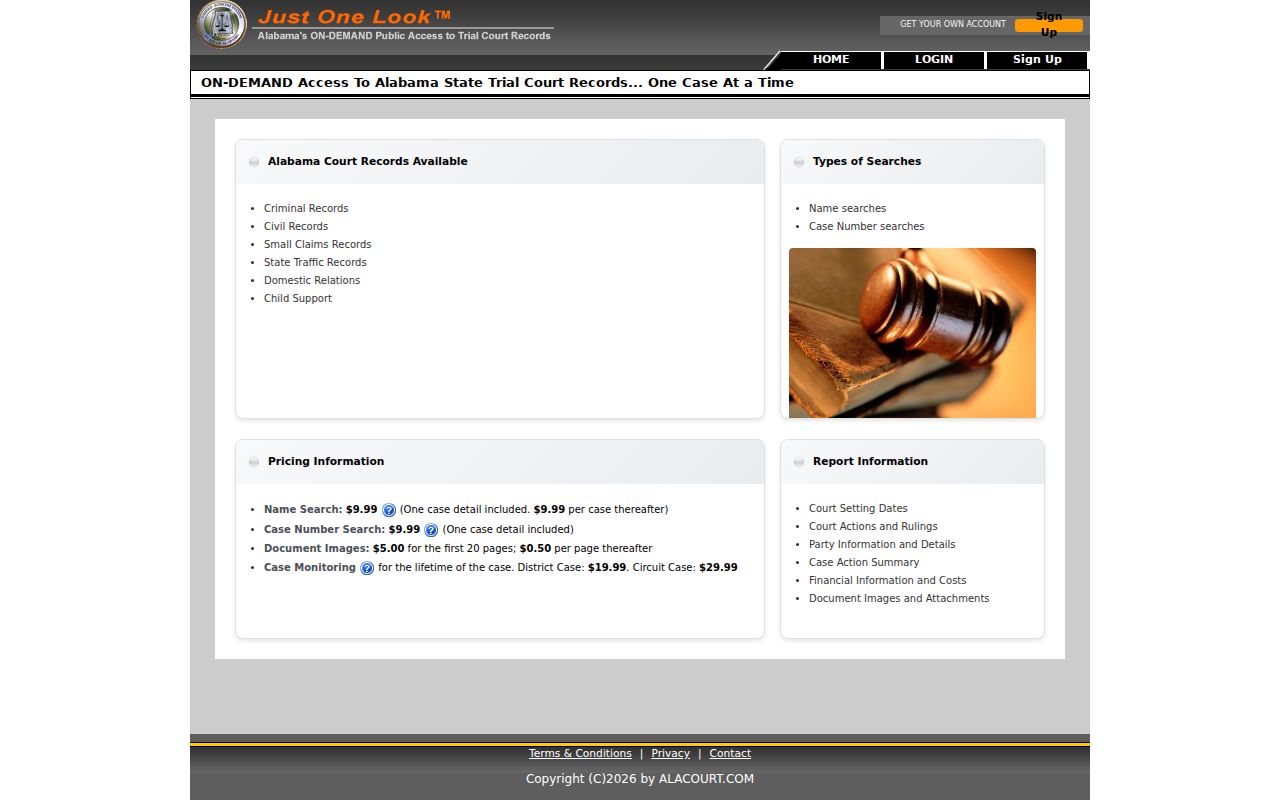
The screen marks the start of a paid court search, not a promise that every city, sealed, unserved, or newly filed Perry County matter will appear.
Perry Court Copy Choices
The Perry clerk's one-page request form offers more than a generic file copy. A requester may select an indictment, warrant, complete file, case-action summary, judgment, payment history, a dated order, the last signed order, or a history check. That choice can save time. A case-action summary gives the event log, while an indictment identifies the felony charge returned by a grand jury. A signed order or judgment is stronger evidence of what the court ruled.
The form charges $25 for a paper history search and $25 for the first 1 to 20 copy pages. Each added page costs $0.50, and certification costs $5 for each item. The fee applies even when no record is found and is not refundable. Personal checks are not accepted, and payment is due on delivery. The clerk asks for seven working days. Most important, the search covers Perry County only. It excludes municipal, federal, other-county, and statewide repository records.
Note: Ask for the narrowest useful document before ordering a complete Perry County court file.
What a Criminal Case File Contains
A Perry County case file follows one prosecution rather than a person's full life history. The case number anchors the file. Pleadings and the charging paper show what was filed, the docket lists events in date order, and orders show what the judge decided. Financial entries may record fines, costs, restitution, and payments. A name match without the right court, case number, filing date, or other identifying detail is too weak to treat as a confirmed match.
| Case Number & Court | Identifies the Perry County division, case type, year, and file. |
|---|---|
| Charging Document | Shows the complaint or indictment and the charge filed with the court. |
| Docket Entries | Lists filings, notices, hearings, motions, orders, and other case events by date. |
| Hearing Dates | Shows settings and completed court appearances when available. |
| Disposition & Judgment | Records dismissal, acquittal, conviction, or another charge-level outcome. |
| Sentence & Conditions | May state confinement, probation, fines, costs, restitution, and related terms. |
Sensitive identifiers, protected victim or minor details, juvenile and youthful-offender material, and sealed or expunged records are not ordinary public fields. Document images may also be unavailable even when a basic docket entry can be seen.
Reading Perry County Case Outcomes
The last docket line is not always the outcome. Perry County case records may show several charges, and each can end differently. Read the judgment and sentence with the case-action summary. A filed charge can differ from the offense named at arrest after prosecutor review. These terms separate an event from a final court result:
- Disposition
- The outcome of a charge or case.
- Nolle prosequi
- A prosecutor's decision not to continue a charge at that time.
- Acquittal
- A not-guilty result after the case is decided.
- Dismissal
- An end to a charge or case without a conviction, subject to the order's terms.
- Sentence
- The punishment and supervision ordered after a conviction.
The classification also points toward the proper court. Alabama Class A through D felonies are tried in Circuit Court. State misdemeanors generally belong in District Court, while qualifying ordinance and traffic matters may remain in municipal court. Enhancements and offense-specific rules can change possible penalties, so the charge class alone does not state the sentence.
Criminal Case Stages in Perry County
A Perry County criminal court file grows as the case moves. The complaint or indictment starts the filed charge. At arraignment, the charge is stated and a plea is entered. Pretrial entries can include motions, discovery-related notices, bond orders, settings, and rulings. A negotiated plea or trial then leads toward a charge-level disposition. If there is a conviction, the judgment and sentencing order state the court's result and terms.
Case flow: Charges Filed → Arraignment → Pretrial → Plea or Trial → Disposition → Sentencing
The older county district attorney page names Drug Court and Pre-Trial Diversion among Fourth Circuit partnerships. Participation should not be assumed from a docket label, and the older officeholder details should not be used as current. The county's current staff directory identifies Robert Turner Jr. as district attorney. Any program completion, dismissal, or resulting order should be verified in the Perry County court file.
Note: A plea entry and a sentencing order answer different questions, so read both before stating the result.
When a Perry County Case Is Missing
A blank portal result does not prove that no case exists. Check spelling, the court division, and the case number first. A recent arrest may not yet have a filed case. An older record may require the clerk's paper route. A city matter may remain with Marion Municipal Court at (334) 683-8969 or Uniontown Municipal Court at (334) 628-2011. Uniontown's GovtPortal is a payment interface, not a proven public docket search.
Warrants need special care. Perry County's Magistrates and Warrants instructions state that an arrest warrant is not public until served. A person who suspects one must appear at the Sheriff's Department, 202 Pickens Street, or call (334) 683-6534. Once public, the clerk form offers a warrant-copy option. A missed date or payment can lead to an alias warrant, so contact the issuing court rather than treating a blank result as clearance.
Perry Court Files Versus ALEA CHRI
A Perry County court case file and an Alabama criminal-history record answer different questions. The clerk file is the source for pleadings, judge's orders, docket events, exact disposition, sentence, and financial entries in one case. ALEA Criminal History Record Information is a fingerprint-linked state compilation of identity data, arrest cycles, charges, and reported outcomes from contributing agencies. Alabama does not provide an unrestricted public name search of that repository.
For personal review, ALEA requires Form 46, a current photo ID copy, fingerprints on an FD-258 card taken by an authorized law-enforcement agency with an FBI-issued ORI, and a $25 money order or cashier's check. If the ALEA record lacks a Perry County disposition, obtain the court's signed order or case-action summary and use ALEA's challenge process. The clerk cannot correct the state repository directly, while ALEA cannot replace the court's own signed record.
Access Rules for Case Records
The Alabama Open Records Act, chiefly Ala. Code §§ 36-12-40 and 36-12-41, supports inspection and copies of public writings subject to other law. Section 36-12-45 adds request categories, response periods, and fee-estimate rules. Court access also follows the Alabama Rules of Court-Record Privacy and Confidentiality, effective in 2025. Those rules preserve a general-access baseline while protecting confidential identifiers and records made private by law or court order.
Juvenile and youthful-offender files, expunged material, sealed records, victim and minor details, personal identifiers, grand-jury deliberations, and some active investigative or security information may be withheld or redacted. Ask for nonconfidential portions when a file contains mixed material. For ordinary Perry Circuit or District copies, the clerk's published form is the first route. For a city file, use its municipal clerk. For a federal case from Perry County, use PACER, since the county clerk cannot supply federal records.