
Perry County Sex Offender Checks
The Alabama Law Enforcement Agency, or ALEA, manages the Alabama Sex Offender Registry through its Criminal Justice Information Services division. Perry County law enforcement supplies registration changes, current photographs, and fingerprints. ALEA then publishes the information that state law permits the public to see. The state says updates enter the registry daily in real time from those local submissions. That makes the state search the main public channel, while the Perry County Sheriff's Office remains the right contact for a local registration or address concern.
Start with a clear search goal. A name search works when the spelling is known. A Perry County, city, ZIP, or radius search is better for community awareness around a home, school route, or other place. Compare the photograph, aliases, physical traits, and reported addresses before deciding that a result concerns the right person. A registry match is a safety record, not a current risk score. ALEA states that it has not individually assessed every listed adult's present dangerousness.
Perry County Registry Reporting
Registration in Perry County begins with the Perry County Sheriff and Jail at 202 Pickens Street in Marion. The published number is (334) 683-6534. The county has not posted registration hours, appointment rules, or fees, so call before going to the office. Staff can explain the current check-in process and route a report about a possibly incorrect local address. The office also provides the practical fallback when an online result raises a location concern that the website cannot resolve.
Perry County Sheriff and Jail
202 Pickens Street
Marion, AL 36756
(334) 683-6534
Call first for registration procedures or to report a local address concern.
If the issue cannot be settled locally, contact the ALEA Sex Offender Unit at (334) 676-7898 or sexoffenderunit@alea.gov. Give specific facts, such as the profile name, listed location, observed discrepancy, and date checked. Do not confront a listed person or household. Local law enforcement and ALEA have access to compliance fields that are not part of the public display.
Alabama Sex Offender Registry Searches
The ALEA Community Information Center is the state starting point for public registry tools and alerts. Its registry path leads to a hosted search interface. The public search must support the place and name options set out in Alabama law, but the hosted gateway did not expose exact button labels, radius choices, sorting, or export controls during research. Use only the visible controls and avoid assuming that a field is required when the interface does not say so.
- Open ALEA's community information page and follow the sex offender registry link. Read and accept the displayed conditions of use.
- Search by name, or choose Perry County, a city or town, ZIP code, or geographic radius for a place-based check.
- Review the result list and compare aliases, photograph, description, and address. Do not rely on the name alone.
- Open the full profile and note the offense history, registration status, locations, vehicles, and any absconded indicator that is publicly shown.
| Field Label | Type | Required | Notes |
|---|---|---|---|
| Name | Text | Unspecified | Search by a known name or alias spelling. |
| City/Town | Text or select | Unspecified | Use Marion, Uniontown, or another known place. |
| County | Dropdown | Unspecified | Select Perry for a county-wide result set. |
| ZIP | Text | Unspecified | Limits a place-based search by postal area. |
| Geographic radius | Address or map inputs | Unspecified | Exact radius choices were not accessible through the hosted gateway. |
The official ALEA landing page shown here illustrates the state-controlled route into community search services.
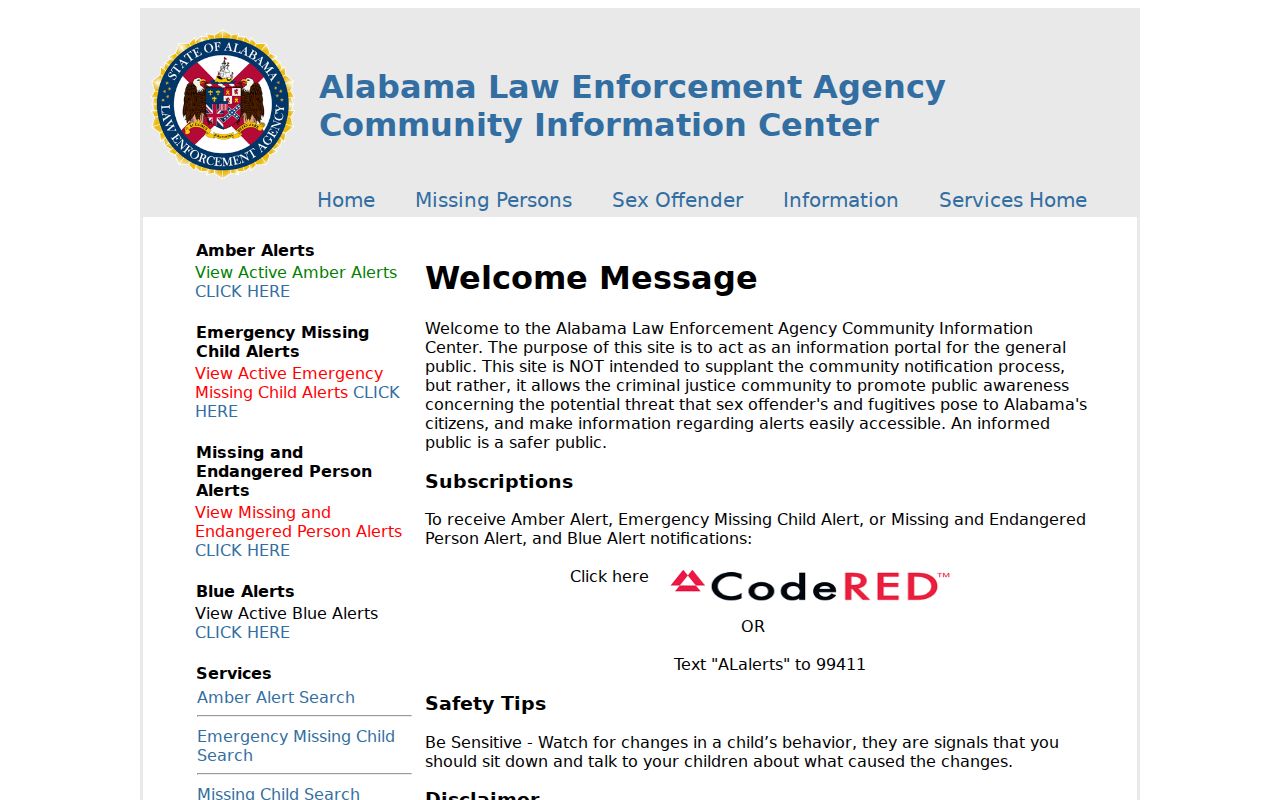
This landing page helps distinguish the state source from an unverified private directory, even though the registry search itself may open on a hosted service.
Perry County Registry Search Gaps
A blank Perry County registry search is not a clean-history finding. ALEA explains that some categories do not appear on the public site. A first conviction for Indecent Exposure or Sexual Misconduct is excluded from public display. Juvenile adjudications generally are not shown unless the person is classified as high risk. Youthful-offender matters generally are not displayed unless the person was over 18 when the offense occurred. A qualifying out-of-state, federal, military, or tribal matter can also require due process before publication.
ALEA's official registry guidance also explains the real-time update process and the limits of public results.
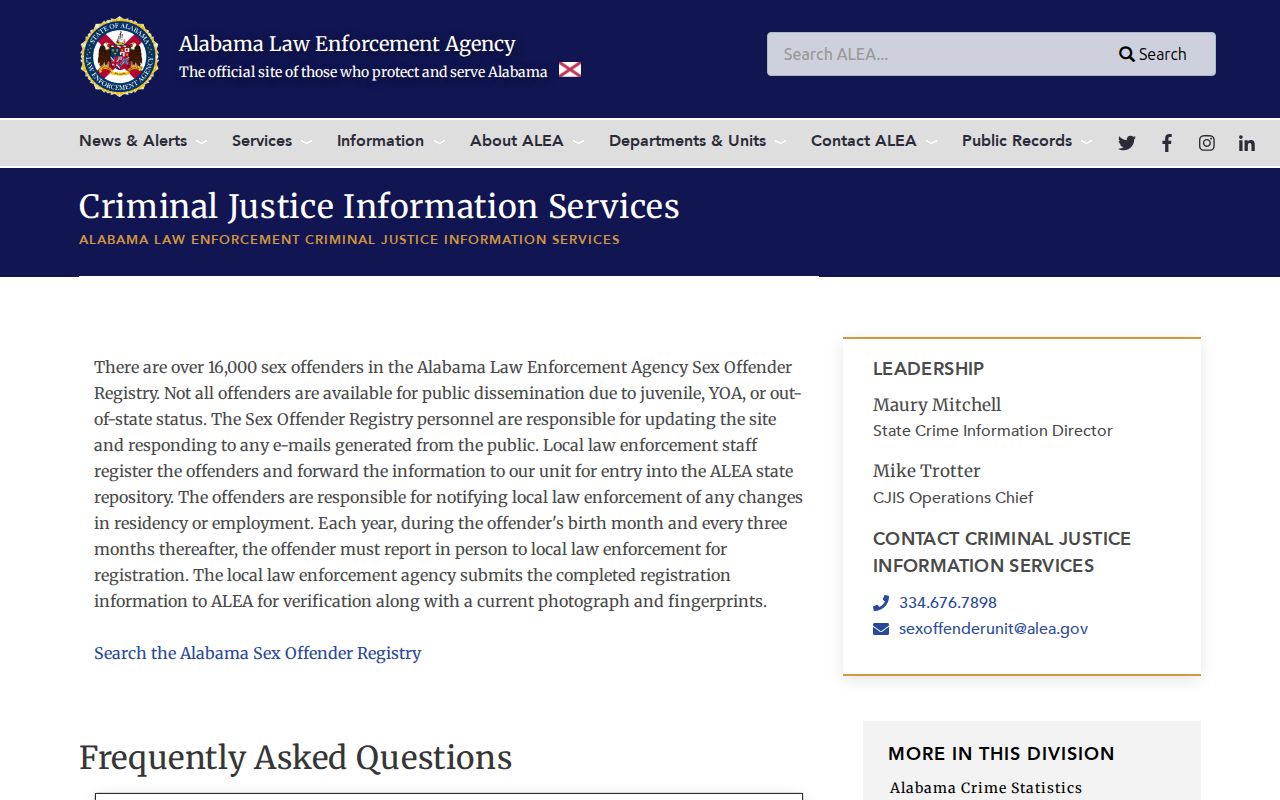
The agency guidance makes the key point practical: absence can stem from legal exclusions or pending process, not just from a lack of qualifying records.
Registry Profiles: What They Show
A public profile is narrower than the registration file held by law enforcement. Under Ala. Code § 15-20A-8, the public product may display identity, location, vehicle, offense, and status information. It excludes non-conviction arrests, Social Security numbers, travel or immigration document numbers, victim identities, internet identifiers, and internet service providers. Those limits protect data that the public registry is not authorized to disclose.
| Name and Aliases | Full registered name and known aliases authorized for public display. |
|---|---|
| Photo and Description | Current photograph plus physical traits that help distinguish similar names. |
| Reported Locations | Each residence and required school or employer address that state law makes public. |
| Vehicles | License plate and descriptions of land vehicles, aircraft, or watercraft used. |
| Offense History | Qualifying sex-offense criminal history and the text of the applicable criminal provisions. |
| Registration Status | Published status information, including an absconded designation when applicable. |
Read each field in context. A residence is a reported registration fact. An offense entry concerns the qualifying history, while the status field concerns registration. Neither should be stretched into a claim about conduct that the profile does not report.
Perry County Registry Fields
ALEA's law-enforcement record contains more than the public Perry County registry profile. Alabama Administrative Rule 760-X-3-.03 describes internal items such as date of birth; FBI, state, and corrections identifiers; race and sex; detailed physical marks; court and offense dates; victim category; compliance, incarceration, and supervision data; warrants or rearrest; cautions; and acknowledgments. Many of these fields stay within law enforcement.
The distinction matters when a public profile looks incomplete. The public site is a disclosure product controlled by statute, not a copy of the entire ALEA registration file. Perry County residents should report a suspected error with enough detail for the sheriff or ALEA to check the nonpublic record. They should not treat an omitted internal field as proof that the agency never received it.
Note: A public profile and ALEA's internal registration file serve different users, so their field counts and detail will not match.
Registration Levels and Duties in Alabama
Alabama does not assign public Tier I, Tier II, and Tier III registration durations to adults. Adult covered offenders generally verify in person during their birth month and every three months after that for life under Ala. Code § 15-20A-10(f). Low, moderate, and high risk labels chiefly shape notification for juveniles. Using a three-tier adult chart from another state would give Perry County readers the wrong rule.
| Alabama Category | Duration | Verification or Notification |
|---|---|---|
| Adult covered offender | Life | In person in the birth month and every three months thereafter. |
| Juvenile specified serious offense | Life, with possible relief petition after 25 years | Registration and notification follow the juvenile provisions. |
| Other juvenile registrant | Generally 10 years | Juvenile registration rules govern the period. |
| Juvenile low, moderate, or high risk | Depends on the juvenile registration category | School, childcare, and public notice increase with the assessed level. |
Alabama law also generally bars an adult covered person from living within 2,000 feet of a school, childcare facility, or resident camp, subject to statutory exceptions. ALEA explains a special 500-foot loitering restriction for certain cases involving a victim under 12. Questions about a specific property or exception belong with law enforcement or qualified legal counsel, not a rough map estimate.
Perry County Registry Versus NSOPW
ALEA is the primary source for Alabama registration information. The U.S. Department of Justice's National Sex Offender Public Website, or NSOPW, searches participating jurisdictions from one interface. Use the Alabama registry for a focused Perry County sex offender lookup and local reporting route. Use NSOPW when a person may have lived in another state or when a location lies near a state line. The national layer does not replace the Perry County Sheriff or make each state's disclosure rules identical.
The official NSOPW search provides the federal cross-jurisdiction interface.
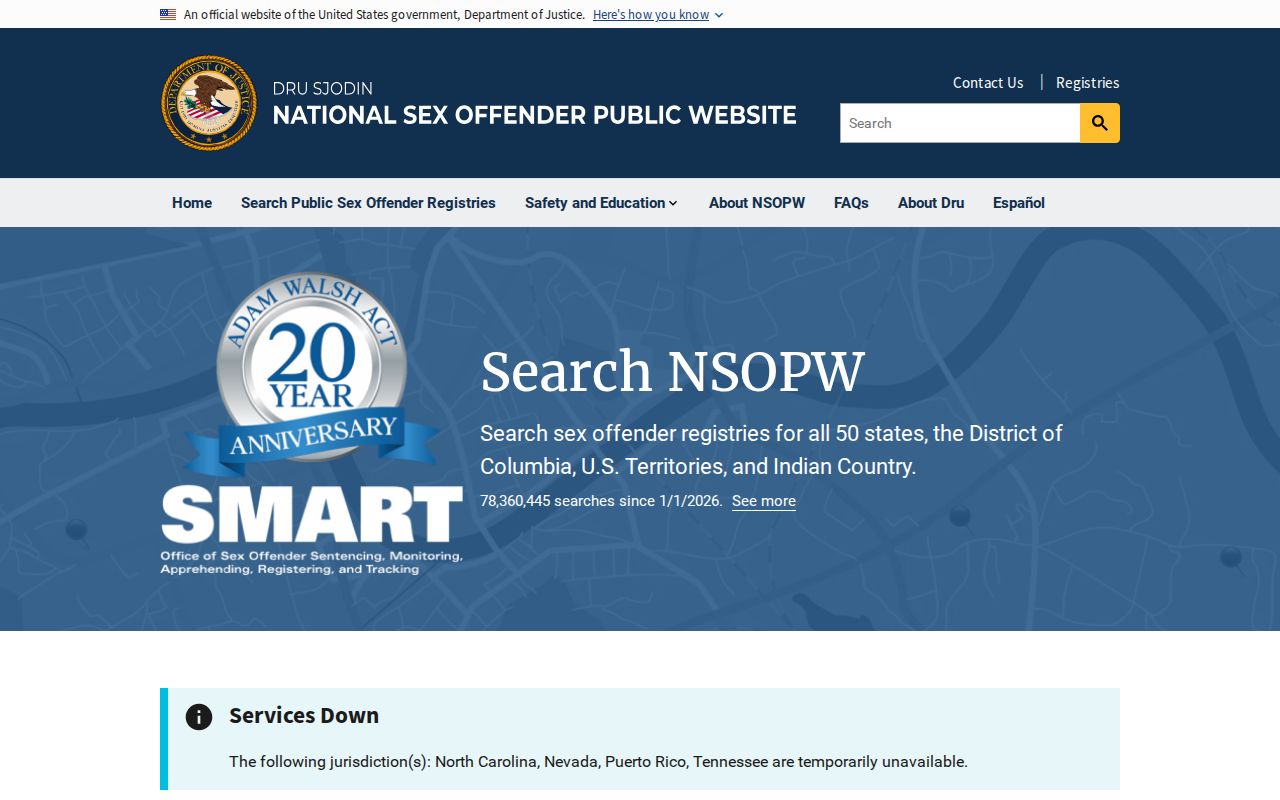
NSOPW broadens geographic coverage, while ALEA remains the better source for Alabama-specific explanations, local update channels, and state disclosure limits.
Correcting Perry County Registry Concerns
If a Perry County profile shows an address that appears wrong, record the profile name, the displayed location, the date of the search, and the exact mismatch. Call the Perry County Sheriff at (334) 683-6534. For a system-level question, contact the ALEA Sex Offender Unit at (334) 676-7898 or sexoffenderunit@alea.gov. These offices can compare public information with registration and compliance data that a resident cannot see.
Keep the report factual. A delayed or incorrect-looking entry may need a local verification, an agency correction, or more context. Do not publish an accusation, visit the address to investigate, or contact the listed household. If the concern involves an immediate threat, use the appropriate emergency channel. Routine location discrepancies belong in the sheriff and ALEA reporting path.
Using Registry Information Lawfully
Alabama publishes registry information for awareness and safety planning. Community notice may also vary with the governing adult or juvenile provisions. A profile should be used to understand reported locations and qualifying history, then paired with ordinary safety steps and official reporting. It should not be treated as permission to contact, follow, expose, or punish a listed person or anyone at the address.
Legal warning: Ala. Code § 15-20A-8 states that registry information may not be used to unlawfully injure, harass, or commit a crime against a listed person or household. Misuse or unlawful harassment can itself be a crime and may bring ordinary civil or criminal penalties.
The warning also guards against false conclusions. ALEA has not made an individual current-danger assessment for every listed adult. Compare the profile carefully, report a true discrepancy through Perry County law enforcement, and let the responsible agency handle compliance work.